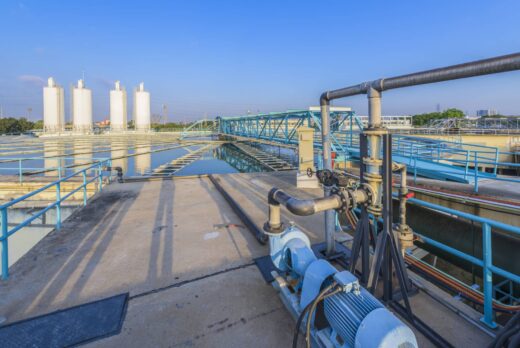
The evolution and development of human activities inevitably leads to the creation of numerous polluting wastes. Among these, wastewater represents a real challenge, especially for communities. Indeed, in order to limit the degradation of natural resources, the depollution of wastewater is essential. In this context, sanitation is an essential process.
Wastewater treatment : definition
Wastewater treatment is a complex process that involves collecting wastewater and cleaning it up. The goal of this process is to clean the water so that it can be safely released back into the environment.
Do not confuse “sanitation” with “water treatment
It is essential not to confuse the process of sanitation with potabilization treatment. Indeed, the purpose of sanitation is to clean the water in order to be able to discharge it into a watercourse for example. This water is clean, but not necessarily potable because of its microbial load. Conversely, the purpose of water treatment is to make the water fit for consumption so that it can be distributed through domestic water distribution networks. The quality of the water is therefore not the same and consequently the treatments differ.

What are the different sanitation systems
There are different types of sanitation depending on the location. There are individual and collective sanitation systems.
Individual sanitation (non-collective)
Collective sewerage systems are installed in areas where settlements are scattered. In this case, each house has its own sanitation system. It can also be a sewage system that treats the wastewater of a small group of houses in a defined area. The system is placed under the house or in its immediate vicinity. It includes :
- A wastewater collection device.
- A tank ensures the anaerobic pretreatment of the flows.
- A device of purification by spreading.
- A system of rejection of the treated water by dispersion in the ground.
It is important to note that in this case, it is the individuals who are responsible for the implementation of the sanitation system. However, the municipality is responsible for controlling the system. The municipality may also maintain the system, but this is not a systematic practice, especially since it involves financial compensation.
Collective sanitation
Collective sanitation systems are used in urban areas or areas with a large number of grouped dwellings. In this case, the system is much more complex and includes different phases of pre-treatment and then treatment of wastewater.
These are collected by a network of sewers that direct them to a treatment unit. There are several sanitation systems for collective use. We distinguish in particular :
- Wastewater treatment plants, which are dedicated to large agglomerations.
- Wastewater treatment plants, which are dedicated to small and medium-sized communities.
- Lagoon treatment plants, which consist of a natural treatment of wastewater through the establishment of a complex ecosystem, composed of plants and various organisms.
Operating principle of a collective sanitation system
The factories and treatment plants that oversee wastewater treatment apply various treatments that vary according to the medium into which the water is to be discharged. The process consists of several successive physical, chemical, physicochemical and biological processes, which are described below.
- Step 1 : Removal of larger wastes (organics, plastics, etc.) by screening. The wastewater sent to the plant passes through a system of coarse screens.
- Step 2 : The wastewater passes through an oil separator and a grit chamber to separate the water from the waste.
- Step 3 : The wastewater is directed into a sedimentation basin for fine particles. This is the primary settling phase.
- Stage 4 : This is the biological treatment phase which ensures the degradation of organic matter, nitrogen and phosphorus compounds by bacteria.
- Step 5 : This is the last step before discharge into waterways. The water passes through a clarifier that separates it from the bacteria.
- Step 6 : The water is now clean, but not potable. It can be safely discharged into nature via a waterway.

It is important to note that during steps 2, 3, 4 and 5, the treatments applied may generate sludge. These sludges include part of the waste separated from the wastewater. It is mainly organic matter, phosphorus and nitrogen. This sludge can be treated or recovered in different ways. It is either used in agriculture to fertilize the soil, incinerated or placed in a landfill.
You now know a little more about wastewater treatment, the processes involved, and the issues and objectives of this mechanism. However, you should know that it is essential to preserve the environment and ensure the safety of people.