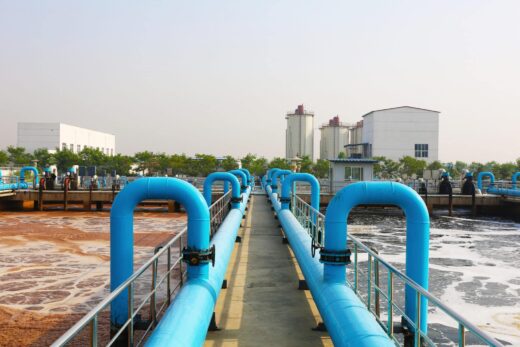
Wastewater effluents are a major cause of surface water pollution. These waters end up in rivers, seas, etc. The problem is that they are loaded with pollutants and substances of all kinds: debris, organic waste, chemicals, suspended solids… Two sources are at the origin of these liquid waste discharges. The first is from so-called domestic water, including household activities and those of agricultural or industrial companies. The second source is runoff water, especially rainwater, from urban areas. All of this wastewater is discharged through sewer systems, but is treated before being released into the environment.
What is wastewater treatment ?
Millions of cubic meters of wastewater are discharged into the sewer system every day. But it cannot be returned to nature without first being treated. The purpose of wastewater treatment is to clean it of the pollutants it carries. It is carried out in three stages that take place in a wastewater treatment plant or a water treatment plant: screening, aeration and potabilization.
The challenges of wastewater treatment
Treating this water before it is discharged is therefore essential to limit environmental pollution. The challenges of wastewater treatment are the protection of fauna and flora, the preservation of nature and the cleanliness of waterways. The ecological dimension is important. The health dimension is also important because the treated water is purified to become drinkable. But the stakes are also economic, because the treatment of this water reduces the impact of drought periods on agriculture, among other things.

Types of wastewater
There are three types of wastewater: domestic wastewater, water from agricultural and industrial activities, and rainwater.
Domestic wastewater
Among the wastewater coming from homes, we distinguish grey water from black water. Grey water includes all water used for household activities, from the shower room to the kitchen and the laundry room. The latter refers to wastewater from toilets, which is loaded with organic matter.
Industrial and agricultural wastewater
Depending on the nature of the activity, this water may contain hydrocarbons, heavy metals, solvents, organic micropollutants or other toxic products.
Rainwater
Originally pure, rainwater becomes slightly polluted as it travels. First, when it comes into contact with industrial fumes. Then, after it runs off various surfaces. Finally, when it is mixed with domestic water in the gutters.
Treatments to clean up wastewater
Wastewater is collected in sewage networks and evacuated to treatment plants. The treatment of wastewater takes place in three phases:
- Screening is the first step to remove all the large waste in the water. It is a mechanical elimination process, using a screen. There are different types of bar screens: coarse bar screens, fine bar screens, static bar screens and mesh bar screens. Resting inside settling tanks, the wastewater sinks to the bottom. Pumps are then used to suck out the remaining sludge. Rotary screens or other innovative methods can also be used to filter the wastewater.
- The second step is aeration: It aims at removing small organic residues from the wastewater. The process consists of injecting air into the tanks in which the water is located. The bacteria in contact with the air cause the organic matter to decompose more quickly and it can be removed. At this stage, the water is cleaned of more than 90% of the pollutants it contained. It can then be returned to natural waterways.
- The final stage of wastewater treatment is the potabilization of the water: the last remaining solids are deposited in a final settling tank from which they are removed. Then, the water passes through a sand filter before being disinfected with chlorine. It can then be returned to the drinking water circuit.
Whether it is screened, biologically treated, chemically treated, de-sludged or screened, wastewater must be treated for ecological and economic reasons. Choose state-of-the-art wastewater treatment equipment. These innovative materials are highly efficient to meet the needs of industrial, domestic or urban wastewater treatment.