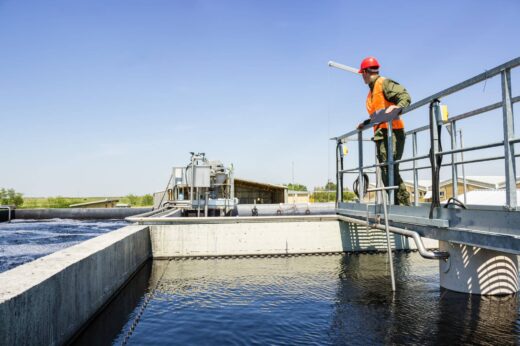
Water is an indispensable resource in the various industrial sectors. That is why factories use large quantities of water on a daily basis. Water is used in the manufacture of all kinds of products. When this water is contaminated, a specific treatment is necessary.
In this article, we will take a closer look at what industrial wastewater is. We will also look at the different issues related to its treatment. Finally, we will list the main techniques that can be used to achieve this.
What is industrial wastewater ?
Industrial wastewater is water that has been used by the industrial and commercial sectors during a product manufacturing process. It is therefore a liquid waste considered as polluted and therefore polluting. All industries use water to create their products.
This concerns the food industry, the textile industry, the computer industry, the automotive industry and many others. Today, it is one of the most important by-products of this type of activity.
Why treat industrial wastewater ?
The water used in the manufacturing process of a product is automatically considered as waste. It is mainly its high content of pollutants and toxic elements that is targeted. Indeed, industrial wastewater can contain organic pollutants, but also inorganic pollutants such as fats, heavy metals, hydrocarbons, etc.
As such, it must be treated in a suitable way so that it can be reused within the plant or discharged into the ground or into water bodies in complete safety. In addition, there are laws in force that strictly control the treatment of industrial wastewater. The challenge is therefore real for factories, which are obliged to implement one or more solutions to treat this liquid waste.
Without this, companies cannot comply with the standards prescribed by the legislation. Investing in an efficient wastewater treatment solution can also reduce a company’s carbon footprint. At a time when global initiatives are multiplying in this area, it is certain that ensuring the optimal management of waste, whatever it may be, also contributes to improving a company’s brand image in the marketplace and with the public.
Depending on the nature of the contamination, different treatment processes may be necessary. This is the subject of the following point.

How to treat industrial wastewater ?
There are several types of treatment to purify and sanitize industrial wastewater. Although some companies choose to work with an external partner to ensure the treatment of their wastewater, it is interesting to know that this is not the only option.
In fact, some plants do not hesitate to take advantage of economic and operational benefits by choosing to treat their wastewater within their own structure. Regardless of the solution chosen, here is a brief description of the different industrial water treatment processes.
Biological treatment
The application of a biological treatment can be an efficient solution to clean the wastewater of a plant when the pollution is biodegradable. In this case, it is a question of implementing a process of depollution and elimination of organic matter. Biological treatments are considered efficient and interesting from a financial point of view. Good to know: there are different processes. Their choice depends on the plant’s sector of activity and the composition of its wastewater.
Physical-chemical treatments
Physical-chemical treatments include a set of cleaning techniques. They allow the treatment of wastewater containing different types of pollutants such as: suspended particles, non-biodegradable organic matter, colloidal substances, oils and greases, dissolved metals and hydrocarbons, among others. Here are the different operations that belong to the category of physical and chemical treatments of industrial wastewater:
- Filtering
- Flotation
- Decanting
- Electrocoagulation
- Coagulation-flocculation
- Precipitation
- Advanced oxidation
- Adsorption
- Neutralization
It is important to note that several treatments can be undertaken in synergy in order to obtain quality treated water at the end of the process. In addition, some plants may install certain equipment upstream of the treatments performed. This makes it possible to carry out a pre-treatment by retaining part of the waste contained in the wastewater. For this purpose, investing in an automatic bar screen is an excellent initiative that improves the overall performance of the water treatment.
Vacuum evaporation
Vacuum evaporation is a technique for the efficient treatment of industrial wastewater. It is particularly effective for the treatment of liquid residues and complex mixtures. In addition, this type of treatment can avoid the creation of liquid spills at the end of the process, which is a major advantage for many plants.
You now know a little more about industrial wastewater treatment. As you will have understood, the stakes of this process are immense for industrialists and for the environment. In this sense, it is an essential step in the management of waste generated by the various sectors of activity of the world’s industry.